Software development studio

Boost Productivity in Minutes with Nova Script Solutions

Tedious work is the kind a computer should be doing. We build the web and mobile software that takes it off your hands — and we say what it will cost to find out, before you commit to building anything.

  • Scope in writing before anything is built
  • A range first, a number after scoping
  • We say when a job is not for us
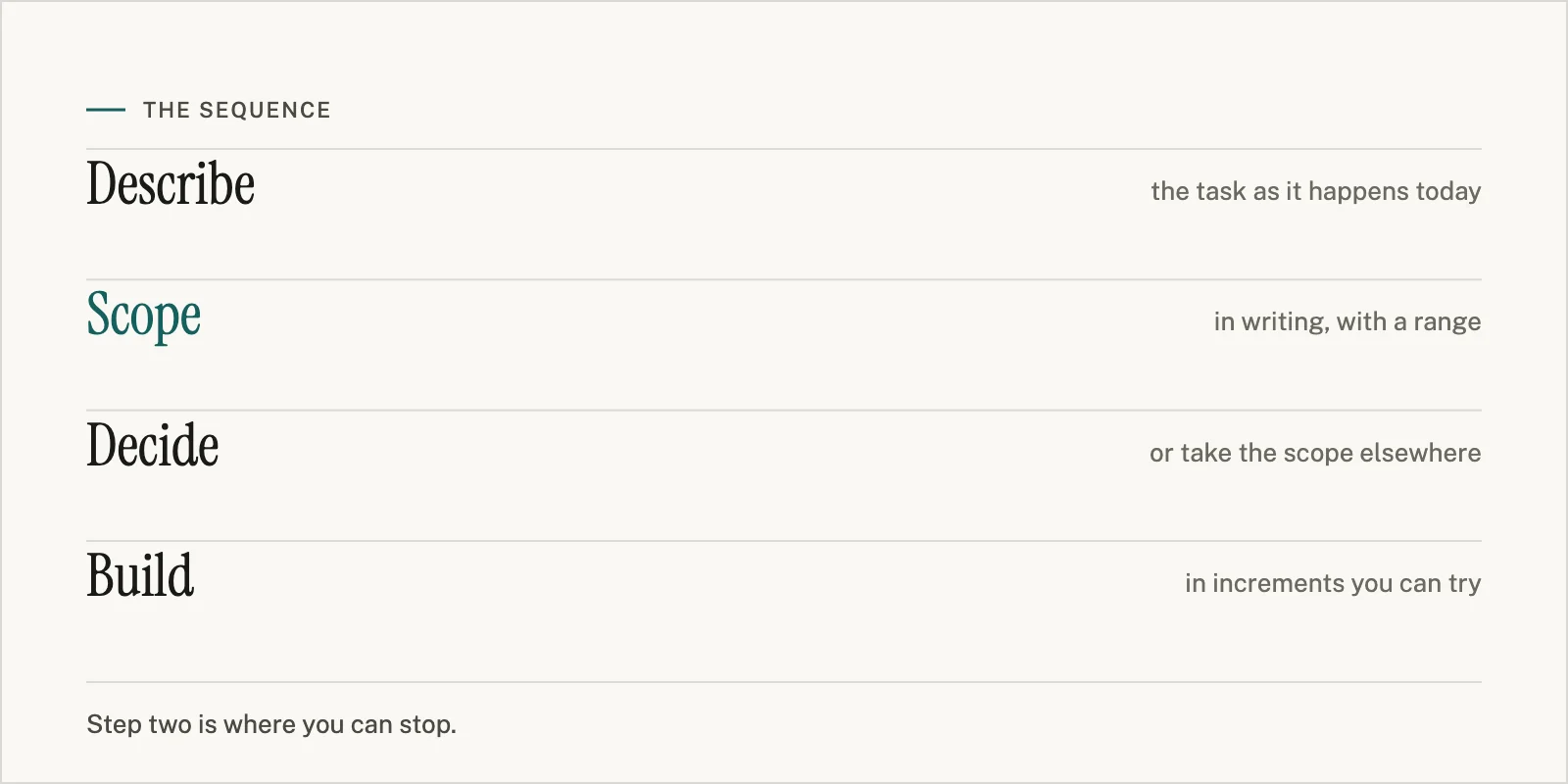
A four-row list — Describe, Scope, Decide, Build — with Scope set in the accent colour and each row annotated, closing on the line: step two is where you can stop.
  • First

    Scope

    • What the task is today
    • Who does it, and how often
    • What “done” actually means
  • Then

    Build and test

    • Working software
    • Tests on the paths that matter
    • A note on what is not covered
  • After

    Keep it running

    • Dependency and security updates
    • Fixes when something breaks
    • Small changes as you need them

What we do

Four disciplines, and the problem each one answers

Web and mobile app development

You have an idea, a spreadsheet or a manual process, and nothing built. We work out whether it belongs in a browser or on a device, write the scope down, then build it.

  • Custom web applications
  • Mobile applications
  • Replacing a manual process
Web and mobile development

Quality assurance and testing

It is built and it keeps breaking, or there is a release you are afraid of. We find the defects before your users do — and tell you when the problem is not testing at all.

  • Pre-release testing
  • Regression coverage
  • An honest read on the cause
Quality assurance and testing

UX and UI design

The software works and nobody can work out how to use it. We separate the problems that are structural from the ones that are surface, and rank them by how many people hit them.

  • Usability review of what exists
  • Interface and flow design
  • Ranked, costed recommendations
UX and UI design

Technical support

It is live and nobody is looking after it, often because whoever built it has gone. We take it over: access, updates, fixes and the small changes that keep accumulating.

  • Updates and security patches
  • Fixes and small changes
  • Taking over someone else's code
Technical support

How an engagement starts

Nothing gets built before it is written down

The decisions that shape a software project are made before much of it is built, and they are cheapest to change while they are still on paper. This sequence exists to make them in the open, and to let you stop after step two if the answer is that the work is not worth doing.

  1. You describe the problem

    Not a specification — the task as it happens today. Who does it, how often, what they start with, what they have to produce, and what currently goes wrong.

  2. We scope it in writing

    A written scope, the list of screens or routes, the questions still open, and a cost range rather than a number. If scoping shows the job is smaller or larger than you thought, you find out here.

  3. You decide with the scope in hand

    A range on paper is enough to compare us with anyone else, or to decide not to build. Taking the scope elsewhere is a legitimate outcome of it.

  4. We build and test in visible increments

    Working software you can try, rather than a demo at the end. Tests on the paths that run every release, and a plain statement of what is not covered.

  5. You own it, and it stays looked after

    Where the repository, the hosting and the store accounts are held in your name, you can change supplier without asking anyone's permission — so it is worth settling in the scope rather than at the end. Support afterwards is a separate arrangement, not an assumption.

What you hold before committing

A scope is a document, not a pitch

Every CTA on this site leads to the same first deliverable. It is worth saying what that deliverable actually is, because “we'll send you a proposal” and “you'll have a scope” are different offers.

  • Written in your language, not ours It describes your process back to you, in terms you can check against how the work really happens. If a line in it is wrong, you will be able to tell.
  • Sized, so the shape is visible The screens or routes listed out, so the size of the thing is on the page rather than implied by a number at the bottom.
  • Honest about what is unresolved The open questions named, with who has to answer each one. These are the decisions that otherwise arrive later as delays.
  • A range, with both ends explained What sits at the low end and what pushes it to the high end. A range whose ends are not explained is just a wider guess.
  • Portable Because it describes the work rather than arguing for a supplier, you can put it in front of someone else and get a comparable quote. That is deliberate.
Start with the task

Fit

What this suits, and what it does not

01

Small and mid-sized organisations

Enough process that manual work is expensive, small enough that one team can still change how things are done. That combination is where this kind of work pays for itself soonest.

02

A task someone does by hand every week

Repetitive, rule-based work with a clear input and output is the cheapest thing to automate and the easiest to scope honestly.

03

Software you inherited

Built by someone who has moved on, still in daily use, nobody sure how it works. Taking one of these over is a defined piece of work with a defined first step.

04

Where a regulated specialist is needed

Work that turns on medical, legal or financial regulation needs a specialist in that field and in that jurisdiction. Say so in the first message and it can be ruled in or out before anyone writes a proposal.

05

Where you need people, not a project

This is scoped project work. If what you need is people inside your organisation permanently, that is a different kind of purchase.

06

Where a date has already been missed

Adding a supplier to a build that is already failing against a fixed public date changes the shape of the problem without changing the date. Worth establishing in the first exchange rather than the second month.

Straight answers

The three questions everyone asks first

What is this going to cost?

Nobody can tell you before scoping, and a supplier who gives you a number on a first call is guessing or quoting a different job. What actually moves the figure: how many kinds of user there are, how many other systems it has to talk to, whether existing data has to be migrated, whether it must work offline, and whether it goes through an app-store review. Scoping produces a range you can compare against another supplier. The number comes after.

How long will it take?

The floor is set by how much has to be decided and how many systems have to be integrated. Three things stretch a timeline, and none of them is coding speed: decisions waiting on someone at your end, access to a system nobody can grant, and a definition of “done” that was never agreed. Scoping is where those get named.

What do I need to have ready before contacting you?

Less than you think. Describe the task as it happens today — who does it, how often, what they start with and what they have to produce. If something already exists, say who built it and whether you have access to the code. You do not need a specification, a budget figure or a technology preference; working those out is the job.

Describe the task. We will tell you if it is worth building.

Three fields and a paragraph is enough to start. If the honest answer is that a spreadsheet already does the job, that is the answer you will get.